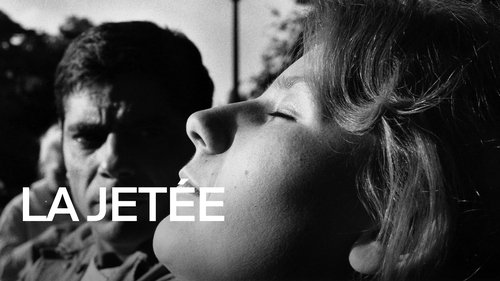





This French short film, created in 1962 during the Cold War, recounts the story of an unnamed man who journeys through time seeking assistance for a ruined Paris. It served as inspiration for "Twelve Monkeys," and I believe it may have sparked the core concept behind "The Time Traveler's Wife." Titled “The Pier,” the film begins at a Parisian airport pier where people observe planes taking off and landing. The movie contains no dialogue beyond narration and quiet whispers; instead, we learn from the narrator that the unnamed Man (Davos Hanich) recalls being at the airport as a child before World War III, witnessing a man fall and die. This image remained with him, along with the face of an enigmatic woman who was also present. Paris has been destroyed by nuclear war, and those who survived have retreated underground. The Man is held captive by whoever emerged victorious from the conflict - we are never told who “won” - and subjected to experiments conducted by a Doctor (Jacques Ledoux). Other prisoners succumbed to the experiments or became incapacitated, but the Man may be different because he possesses vivid memories, such as that of the airport, to draw upon. The Doctor’s plan is to send the Man either into the past or ahead to the future in order to secure aid for their present situation. The Man receives injections, a wired blindfold is placed over his eyes, and then he begins time traveling, though at a very slow pace. After a week and a half, he starts seeing images reminiscent of his key memory – the airport. Then, after nearly a month has passed, he encounters an unnamed Woman (Helene Chatelain). The Man finds himself somewhere in the past, repeatedly encountering this same woman. They wander through gardens together, and eventually the Man explains the reason for his visits as the Woman listens attentively. What troubles the Man most is whether he’s moving between points in time, inventing the Woman in his mind, or recalling a genuine encounter that he's only now remembering. The conclusion arrives abruptly and leaves a lasting impression. I had forgotten this was the foundation for Terry Gilliam's best film, but what really resonated with me was how this story could have presented Eric Bana’s perspective in "The Time Traveler's Wife." The Man contemplates what the Woman might think as he unexpectedly appears to spend time with her. Due to its O. Henry-like storytelling structure, all-knowing narration, and black and white photography from the early 1960s, I would compare it to a particularly strong episode of "The Twilight Zone.” Aside from a brief moment where the Woman blinks, the film is entirely composed of still photographs and voiceover narration. Although some viewers might associate this with film strips from school days, the technique becomes easy to accept and functions as an oral history, offering a glimpse into a potential future war. It’s challenging to deliver a performance based on what amounts to a series of photographs, but Hanich and Chatelain both utilize their expressions skillfully. Writer/director Marker avoids transforming this into a sprawling science fiction narrative; the war is only alluded to, and the time travel mechanics don't make much sense. He maintains viewer interest by keeping the Man in the dark as well – we discover things alongside him. The ending is deeply sad and impactful. I felt that the musical score was occasionally too prominent, but perhaps it reflected the Man’s reaction to falling for the Woman, thereby sentimentalizing his feelings. "La Jetée" stands out as a very powerful short film, and it's understandable why it inspired Gilliam’s more elaborate work. In this unusual instance, I would have liked to see Marker develop this bleak vision of the world further.
On September 24, 2026
#15493▼ 1191
15493rd by Pulse movie online22.0PULSEPulse MeterOur daily Pulse Meter measures public activity and popularity signals across the web.How it works →