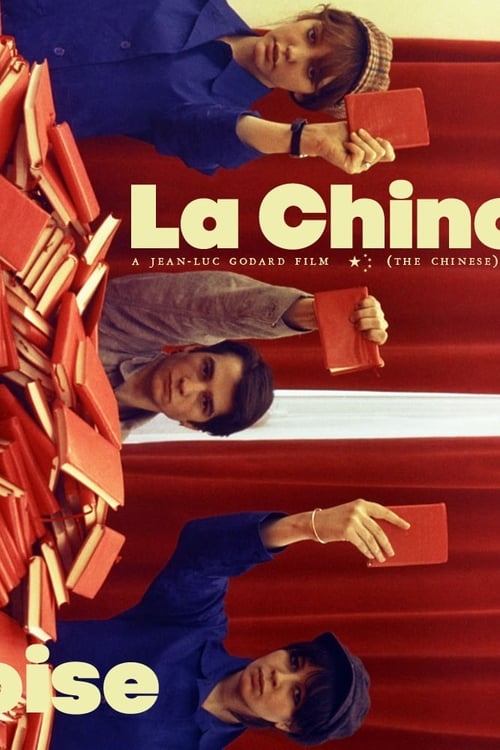





In 1966, Jean-Luc Godard encountered some young French leftists drawn to Maoism. They were looking toward China as an escape from the traditional divisions within the French Left—those supporting the Soviet Union, which had seemingly lost its revolutionary spirit, and Trotskyist factions that seemed powerless. It’s worth noting that at the time, Westerners generally weren't aware of the devastating consequences of Mao’s policies. Godard, who was deeply engaged politically and possessed a strong sociological curiosity during this period, decided to examine this phenomenon, resulting in LA CHINOISE. While he would later create films with overtly political messages that felt heavy-handed, this one pleasantly surprised me with how engagingly the story unfolded and how insightful its observations were. The film takes place in a Parisian apartment borrowed for the summer while one resident's parents are away, where a group of young radicals consider themselves part of a revolutionary cell. Key figures include Guillaume (Jean-Pierre Léaud), Véronique (Anne Wiazemsky), and Yvonne (Juliet Berto). They read daily from Mao’s writings, criticizing both the Soviet Union and French society, while practicing persuasive speeches for their infrequent attempts to spread their message in public. Eventually, they decide that violence is necessary to achieve their goals and ostracize the only one who opposes it, expelling him from the apartment. Francis Jeanson, a French academic and opponent of the Algerian war—and Wiazemsky’s actual thesis advisor—appears as himself in a scene where he tries to dissuade Véronique from violence, questioning how much support she believes she has from those they claim to represent. I don't think Godard truly embraced Maoism or revolutionary socialism at his core, despite his desire for a cause. His discontent with the established French order is evident, and he appreciates that these French Maoists recognized the need for change, but LA CHINOISE gently critiques its subjects more than it celebrates them. Rather than convincingly portraying Maoism as a viable path forward, the film ultimately suggests it was merely the latest manifestation of the generational drive to rebel—a tendency that arises in every new generation of young people. While these characters identify with Maoism, Godard borrowed the fundamental structure of the plot from Dostoyevsky, who previously described a group of radicals. The director highlights how seriously these idealistic individuals take themselves, showing their adoption of Maoist art as a trend and their use of Maoist terminology as current slang. There are amusing moments throughout, thanks to Godard’s characteristic dry humor and witty dialogue. The occasional application of Brechtian techniques—like when Guillaume abruptly breaks character and speaks directly to cinematographer Raoul Coutard—encourages the viewer to reflect on what's happening onscreen. Despite Godard's revolutionary leanings, LA CHINOISE maintains a connection with film history (cinephiles will notice the brief avant-garde clip that occasionally appears in the soundtrack, a clear reference to Ingmar Bergman’s PERSONA). Like Godard’s early films in color, this one is visually appealing. A significant portion of the first half seems like a study of faces: Léaud's well-known expressiveness, Wiazemsky's distinctive features and her habit of turning her mouth slightly to the left when she speaks, and Berto’s somber eyes. The set design is clever, filled with small details. It's good that Gaumont has re-released this film on Blu-Ray (with English subtitles), allowing viewers to fully appreciate these nuances in high definition. I wouldn’t suggest LA CHINOISE to those unfamiliar with Godard’s earlier works, but I consider it one of his better films and believe it will impress anyone who has grown fond of this filmmaker's style.
On September 30, 2026
#32715▲ 114
32715th by Pulse movie online1.2PULSEPulse MeterOur daily Pulse Meter measures public activity and popularity signals across the web.How it works →