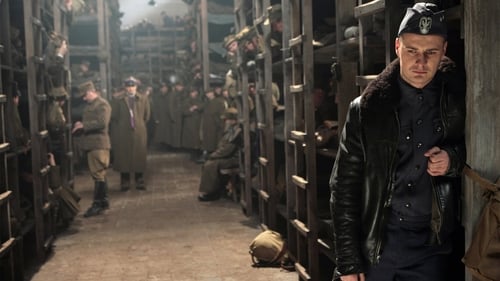




I can’t recall another film about wartime experiences where the Germans and Soviets attempted to hold each other responsible for some of the atrocities in Poland, making this movie surprisingly revealing. The story begins in September 1939, a time when ordinary Polish people were desperately unsure of what to do. Their cities were being destroyed, and whatever remained of their military was easily defeated by invading forces. Initially, only officers were being held; private soldiers and families were mostly left on their own. However, it soon became apparent that this was just a temporary measure while prison trains were prepared to transport these men to camps in the East. “Anna” (Maja Ostaszewska) finds herself caught up in this situation when she and her daughter "Nika" are separated from her husband "Capt. Andrzej" (Artur Zmijewski). At that point, it might have been possible for her to go to the area occupied by the German military where her parents lived in Krakow, but after being denied a permit three times, she becomes increasingly aware of the dangers and has to depend on a kind Russian officer to get her to what she hopes will be a slightly safer place. In 1943, with the Nazis now controlling this region, they discovered mass graves and blamed the previously retreating Russian forces. They exhumed the remains and performed "thorough" autopsies, identifying many of the murdered men through loudspeakers so their families could hear, living in fear that their husbands, fathers, and sons would be named. By 1945, the fighting had shifted, and it became the responsibility of the Soviet forces to expose the full extent of the extermination of approximately 22,000 Polish officers; but with both sides repeatedly accusing each other of the killings, it’s nearly impossible to determine who was truly behind these crimes. Will this family ever be reunited? This is obviously a subject very important to Andrzej Wajda, and by combining a touching story about a family with genuinely disturbing archival footage from the real Katyn discoveries, it begins to systematically demonstrate which of these military regimes was responsible not only for these executions but also what happened to anyone on their own side who protested or tried to disobey. It also shows something of the psychological damage experienced by both those imprisoned and those waiting for news; a sense of fear and despair—all within a convincingly realistic production that powerfully captures the imagery of war, along with its associated poverty and horror. It's an unsettling film, made even more so by the complete lack of hope throughout, and it’s quite a powerful commentary on humanity's capacity to be truly cruel.

On September 22, 2026
#16506▼ 334
16506th by Pulse movie online27.6PULSEPulse MeterOur daily Pulse Meter measures public activity and popularity signals across the web.How it works →














