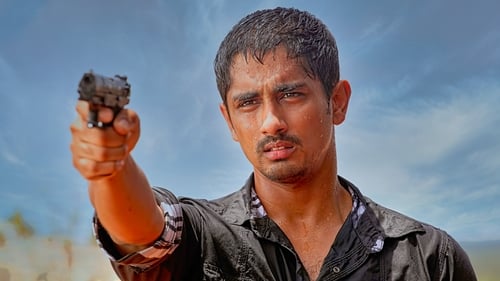




A poignant moment in Jigarthanda features an older man sharing advice with Karthik, a young filmmaker about to direct his first movie. The man explains that debut directors often demand everything and refuse compromise, recounting how he once turned down a producer’s request to cast relatives, choosing instead to seek out other funding sources. He then says, "Aana, kadaisi varikkum aayirathula oruthan kooda varala," suggesting Karthik should seize the opportunity before him, regardless of any conditions attached. Considering Jigarthanda was the first script Karthik Subbaraj wrote before making Pizza—a film whose popularity is evident from the audience’s reaction to his name appearing in the credits—he understands how a filmmaker can creatively navigate compromise. This concept lies at the heart of the movie: a filmmaker forced into an undesirable deal ultimately transforming it into a valuable opportunity. The story begins with an award-winning director (Nasser, in a brief appearance) and a producer (Naren) arguing about Karthik's (Siddharth) short film after a reality show screening. The director dismisses it as "kuppa padam," while the producer, seemingly harboring personal grievances, declares it the best he’s seen and offers to finance Karthik’s first feature. However, he insists on a violent gangster movie rather than a socially conscious one, citing Hollywood examples like *The Godfather*, *Scarface*, and films by Tarantino, instructing Karthik to "Idhu madhiri oru script ready pannu," or even to simply write the script himself. But true to his principles as a first-time filmmaker, Karthik decides to base his film on a real-life gangster. He learns about Assault Sethu (Simhaa), a powerful figure in Madurai, and travels there to research him for an authentic portrayal. He enlists the help of his friend Oorani (Karuna, reprising his role from *Yaamirukka Bayamey*), but their progress is slow. Unexpectedly, Sethu enters their lives, creating situations that threaten both Karthik’s career and his safety. If Pizza was a clever deception disguised as a horror film, Jigarthanda is essentially a comedy presented as a gangster movie. The first half delivers the action-packed thriller promised in the trailers—a captivating and intimidating villain, his unusual associates (including a teetotaler with a secret weakness), brutal violence, and a suspenseful climax. Even the cinematography by Gavemic Ary stands out, particularly a long shot during an assassination attempt. The female lead is also well-developed and isn't merely present for a romantic subplot; she and her mother, an idli vendor who cooks for Sethu, are Sourashtrians—a detail shared with another recent film, *Naan Than Bala*—and they’re involved in stealing saris from stores. The tone gradually shifts in the second half, unlike Pizza, where a single revelation altered the entire perception of the movie. Here, the audience doesn't notice a change in genre as the mood lightens and then becomes more serious again. While the intensity decreases somewhat in the latter portion—with echoes of the Malayalam film *Udayananu Tharam* (influenced by *Bowfinger*)—it’s not an imitation. Sethu’s ultimate transformation feels slightly predictable and sentimental, but the actors, especially Simhaa who dominates the role and excels in the finale, largely overshadow this shortcoming. Karthik Subbaraj has described the film as a musical gangster movie, and its soundtrack reflects a diverse range of influences. Santhosh Narayanan incorporates everything from energetic Tamil folk music to scores reminiscent of Ennio Morricone’s work on spaghetti westerns, alongside popular songs. The film opens with Paasa Malar's *Malarnthu Malaratha* playing in a theater during a shootout, then transitioning into Karthik's ringtone—a common stylistic choice. It also includes the obligatory Ilaiyaraaja song (*Kadhalin Deepam Ondru*) and even something as recent as *Pesuren Peuren* from *Pannaiyarum Padminiyum*. When the heroine recites a poem referencing rain and Ilaiyaraaja to emphasize that the 1980s were more than just his era, Sethu reveals he’s a fan of Shankar-Ganesh. This rebellious spirit is what makes this film unique and solidifies Karthik Subbaraj's position as an exciting filmmaker.
On September 23, 2026
#49980▼ 861
49980th by Pulse movie online11.0PULSEPulse MeterOur daily Pulse Meter measures public activity and popularity signals across the web.How it works →