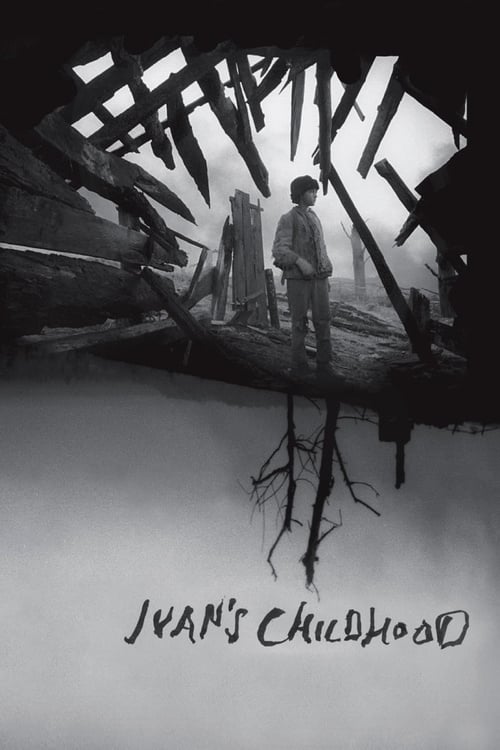





Andrei Tarkovsky’s debut feature, 1962's *Ivan’s Childhood*, adapts a short story by Vladimir Bogomolov and takes place during World War II. The film centers on a twelve-year-old orphan (Nikolai Burlyaev) operating on the Eastern Front; his small stature enables him to observe German positions without being noticed. While Ivan’s reconnaissance has been helpful, officers like Lt. Col. Gryaznov (Nikolai Grinko), Capt. Kholin (Valentin Zubkov), and Lt. Galtsev (Evgeny Zharikov) want to send him to a military academy and remove him from the fighting zone, particularly with a final push against the Germans approaching. The story unfolds between two of Ivan's missions across the Dniepr River into territory controlled by German forces. It portrays the hardships faced by soldiers at the front lines and the devastation war inflicted on a Soviet village, now occupied by the army and consisting of damaged buildings. Details about Ivan’s past are gradually revealed through conversations among the soldiers, dreamlike sequences, or flashbacks. A separate storyline focuses on Capt. Kholin's unsettling attempts to pursue Nurse Masha (Valentina Malyavina), presenting a departure from earlier Soviet war films by implying that comrades can be as threatening as the enemy. Even for Tarkovsky’s filmography, *Ivan’s Childhood* feels like an early work; it lacks the deliberate, almost ceremonial pacing characteristic of his later movies and runs just 90 minutes. Nevertheless, certain scenes (a camera following a wall, Ivan looking through a book illustrating religious art) hint at the mature style he would develop, as does the noticeable presence of religious symbols such as crosses and frescoes. Vadim Yusov’s cinematography is striking, utilizing multiple visual planes in some shots and frequently framing characters with broken wooden beams that seem to obstruct their progress. I was quite let down by the film's conclusion, which abruptly shifts into a standard Soviet anti-German propaganda piece featuring archival footage of the Soviets taking Berlin; it felt as if an entirely different director had stepped in.
On September 29, 2026
#7205▲ 1529
7205th by Pulse movie online39.9PULSEPulse MeterOur daily Pulse Meter measures public activity and popularity signals across the web.How it works →














