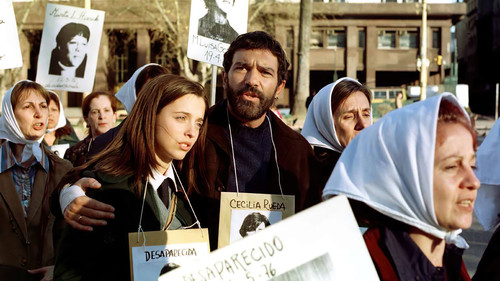




It's difficult to conceive that anyone could have come up with a story like *Imagining Argentina* unless they were willfully oblivious. Given that Christopher Hampton, who has previously adapted screenplays for films such as *Dangerous Liaisons*, *Mary Reilly*, *The Quiet American*, and *The Father*, directed and wrote this film, I can only place the blame on Lawrence Thornton, whose novel served as the inspiration—or perhaps a more accurate description would be the catalyst—for this awful movie. The story unfolds in 1977, set in an Argentina where everyone speaks English with various Hispanic and Latin American accents that bear no resemblance to Argentinian speech patterns. The one exception is Emma Thompson, who maintains her natural British accent despite playing a character named Cecilia Rueda. She works as a journalist in Buenos Aires; after publishing an article criticizing the forced disappearance of students protesting bus fares, Cecilia is abducted by the secret police. With authorities displaying indifference and likely complicity, her husband Carlos (Antonio Banderas) puts up posters featuring Cecilia's picture, though I doubt they’ll be helpful considering the information on them is printed in Spanish, and as previously mentioned, everyone speaks English. However, this linguistic inconsistency isn't the most shocking aspect of the film. No; that dubious distinction belongs to the fact—and I assure you, I am not fabricating this—that Carlos possesses psychic abilities. Seriously. Carlos is producing a play for a youth theater group, and one day, seemingly out of nowhere, he tells an actor that his father, who was also kidnapped, will be released later that evening. “It felt like I was recalling the future,” he explains to his friend and colleague Silvio (Rubén Blades, who appeared in *Once Upon a Time in Mexico* the same year; it’s remarkable that the latter film turned out to be more realistic). The entire production feels like a bizarre combination of *Tell Me How I Die* and the *Saturday Night Live* sketch featuring Chris Walken as a "trivial psychic," except there's nothing trivial about state terrorism in Argentina during the 1970s and 80s. Carlos’s prediction proves accurate, which could have been mere coincidence; nevertheless, he never questions his newfound abilities and soon summons the Mothers of Plaza de Mayo to reveal what happened to their loved ones. This is deeply insensitive, offensive, and disrespectful. It not only diminishes a significant tragedy but also, seemingly unintentionally, casts doubt on its reality. Consider that an average moviegoer might be unfamiliar with the full scope of the atrocities committed during Argentina’s last dictatorship, but they certainly know that in real life no one can "remember the future." If the film carelessly exaggerates this point, who could fault someone for assuming that the former is equally fabricated? As it stands, the graphic scenes of rape and torture presented are gratuitous because they occur within a world that doesn’t resemble reality. Films like *Night of the Pencils* and *The Official Story* are far better—not only because they were made in Spanish and created by Argentines, but most importantly because they treat their subject matter with the seriousness it deserves. *Imagining Argentina* is, and this is its least egregious flaw, superfluous. But if they felt compelled to make it, why not have altered Carlos from a genuine psychic into a con artist who gradually changes his perspective as he becomes more acquainted with the stories of those he’s deceiving? That way, it wouldn't be the filmmakers themselves who appear to be the swindlers.
On September 24, 2026
#24043▼ 1758
24043rd by Pulse movie online20.9PULSEPulse MeterOur daily Pulse Meter measures public activity and popularity signals across the web.How it works →














