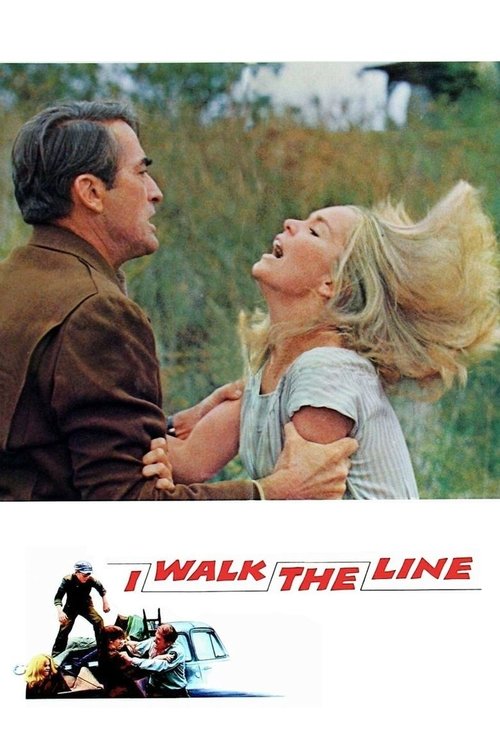




This isn't to be mistaken for the 2005 biographical movie about Johnny Cash—though it does incorporate several of his songs—"I Walk the Line" (1970) features Gregory Peck as a quiet Appalachian sheriff experiencing a mid-life crisis and becoming infatuated with a younger woman (Tuesday Weld), who happens to be the daughter of a long-time moonshiner. The sheriff overlooks some things, and everything seems okay for a while, but how long can that last? Gregory Peck is always reliable; even though I’ve only seen around a dozen of his films over the years, he's consistently been someone I enjoy watching. He’s tall, seemingly honorable, masculine, likable, determined, and possesses an understated quality that makes him shine. In this film, he largely embodies his familiar persona, except for the fact that, grappling with a mid-life crisis, he makes questionable decisions and causes pain to those around him. Tuesday Weld was 26 during filming and is pleasing to look at. Her character retains a sense of innocence despite her actions being wrong. It’s fair to say she's more naively amoral than deliberately immoral. The film showcases the gorgeous Appalachian hills of North-central Tennessee. Scenes set in the town square were filmed in Gainesboro, but the dam scene that opens the movie (and reappears later) was shot at Center Hill Dam. The Drive-In sequence where they’re watching the 1969 Jerry Lewis film "Hook, Line and Sinker" took place at the Green Hills Drive-in in Carthage—Al Gore's hometown—about 45 minutes from Gainesboro. During production, Gregory Peck, Tuesday Weld, director John Frankenheimer, and other cast and crew stayed at the Holiday Inn in Cookeville, TN. Most of the buildings in Gainesboro remain standing (including the pool hall), with only one exception: the store across from the courthouse where the sheriff shops was torn down. A small portion of filming also occurred in Northern California, in a town called Colusa, the seat of Colusa County; I'm not sure which scenes were shot there. Much of Colusa’s architecture has a distinct Southern feel and has been used in various movies. I appreciate the film’s message: actions have consequences—poor choices will inevitably harm both yourself and those connected to you, while good choices benefit everyone involved. The movie effectively demonstrates how an admirable man can be diminished to something ordinary simply by giving in to temptation. The story unfolds with a naturalism characteristic of films from the 1960s and 70s before the rise of formulaic "blockbusters." I find this appealing, but others might not enjoy it, particularly the somewhat slow pace of the first act; however, the narrative gains momentum in the second act and maintains its interest until the end. Some viewers dislike the film because Peck is playing a flawed and lonely character—a departure from his usual roles. This may explain why he accepted the part; at 53, he likely saw it as a challenge to portray someone who isn't simply a hero or villain, but rather a person feeling trapped by routine and meaninglessness, making a desperate attempt to feel alive again through an attraction to beauty. Peck handled this well, though it understandably can provoke feelings of disapproval from the audience. "I Walk the Line" is a worthwhile film that has been largely forgotten over time. It’s similar in tone to "Deliverance," but without the sexual violence and with more emphasis on drama and everyday life than adventure. The movie's running time is 1 hour, 37 minutes. GRADE: B
On October 2, 2026
#33564
33564th by Pulse movie online2.1PULSEPulse MeterOur daily Pulse Meter measures public activity and popularity signals across the web.How it works →