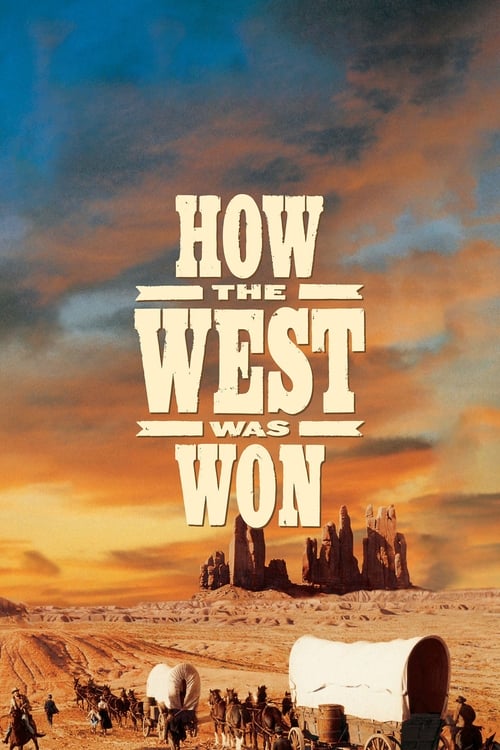




_**A sprawling, star-studded Western epic assembled from separate stories offers a mixed experience**_ Released between 1962 and 1963, "How the West was Won" is an expansive Hollywood Western penned by James Webb, spanning fifty years from 1839 to 1889. The film follows the Prescott family’s journey westward and features narration by Spencer Tracy, blending historical elements with melodrama, romance, adventure, violence, and musical numbers. The movie was presented in Cinerama, a short-lived cinematic technique involving synchronized projectors and a curved screen. It was one of only two films with a traditional narrative to use this process, the other being "The Wonderful World of the Brothers Grimm," released concurrently. While intended to help film compete with television, Cinerama’s cost and complexity ultimately limited its adoption. Despite that, "How the West Was Won" proved commercially successful. While there were other large-scale Westerns both before and after, such as "The Big Country" (1958), "The Alamo" (1960), "Dances with Wolves" (1990) and "Wyatt Earp" (1994), “How the West Was Won” distinguishes itself through its structure: five self-contained segments directed by three different filmmakers. THE RIVERS (1839), directed by Henry Hathaway, may initially deter viewers with what feels like a saccharine, Disney-esque portrayal of westward expansion and clichéd dialogue, especially the hasty romance between Linus Rawlings (James Stewart) and Eve Prescott (Carroll Baker). However, this changes abruptly when the travelers encounter a ruthless gang of river pirates (Walter Brennan, Lee Van Cleef, and Brigid Bazlen). The shift from lighthearted family entertainment to shocking violence is striking; one villain receives an axe wound in his back and another a knife thrust to his chest. The segment concludes with a suspenseful rafting sequence. Karl Malden plays the patriarch, while Debbie Reynolds portrays the less romantically inclined sister. I must say that the producers made a good choice casting Baker, Reynolds and Bazlen; all three are captivating. THE PLAINS (1851), directed by Henry Hathaway, shows Lilith Prescott (Reynolds) working as a dance hall performer in St. Louis after learning she has inherited a gold mine in California. A charming gambler (Gregory Peck) becomes aware of this and joins the wagon train, led by Robert Preston’s character. Both men desire Lilith's attention, but she seems uninterested in the latter’s apparent sincerity. This segment is highlighted by Reynolds’ beauty and her entertaining song-and-dance numbers, as well as a thrilling Cheyenne attack on the wagon train. THE CIVIL WAR (1861-1865), directed by John Ford, depicts Zeb Prescott (George Peppard), Lilith's son, enlisting in the Civil War after his father had previously served. This segment is the weakest part of the film because scenes featuring Ulysses Grant (Harry Morgan) and General Sherman (John Wayne) are clearly filmed on a studio set, and the Shiloh battle sequence feels abbreviated. What a disappointment! THE RAILROAD (1868), directed by George Marshall, finds Lieutenant Zeb working in the U.S. Cavalry, attempting to maintain peace with Native Americans while befriending buffalo hunter Jethro Stuart (Henry Fonda). Zeb grows disillusioned when an arrogant railroad executive (Richard Widmark) violates treaties with the Arapaho people by building through their lands. The Natives respond by stampeding bison into the railroad camp and causing numerous casualties. It’s a visually impressive sequence. THE OUTLAWS (1889), directed by Henry Hathaway, shows Lilith, now widowed, relocating to her remaining ranch in Arizona and inviting Zeb (Peppard) and his wife (Carolyn Jones) and children to manage it. Marshal Zeb faces threats from a vengeful outlaw (Eli Wallach). Rather than waiting for the criminal’s attack, Zeb takes the offensive with the assistance of reluctant Marshal Lou Ramsey (Lee J. Cobb). They hide out on a train carrying a substantial gold shipment to ambush the outlaw and his gang. The exciting climax is notable for its impact at the time and its clear influence on action-oriented films. As you can see, the movie consists of loosely connected stories with certain characters appearing in multiple segments (Baker, Reynolds, Peck, Peppard). It’s a large film rather than an exceptional one. However, it deserves recognition for its uniqueness and ambition in attempting so many different forms of entertainment. The score by Alfred Newman, for example, stands out as one of the finest film compositions ever created. While the movie occasionally falls short — particularly the initial “Disney goes West” feel and the brief Civil War sequence— there’s enough compelling material to avoid a negative assessment. Viewers should be prepared to accept its quirks and unusual nature because "How the West was Won" is unlike any conventional Western. The film runs 164 minutes and was filmed in Kentucky & Illinois in the East; and South Dakota, Utah, Arizona, California and Oregon in the West. GRADE: B
On October 2, 2026
#10225
10225th by Pulse movie online3.3PULSEPulse MeterOur daily Pulse Meter measures public activity and popularity signals across the web.How it works →