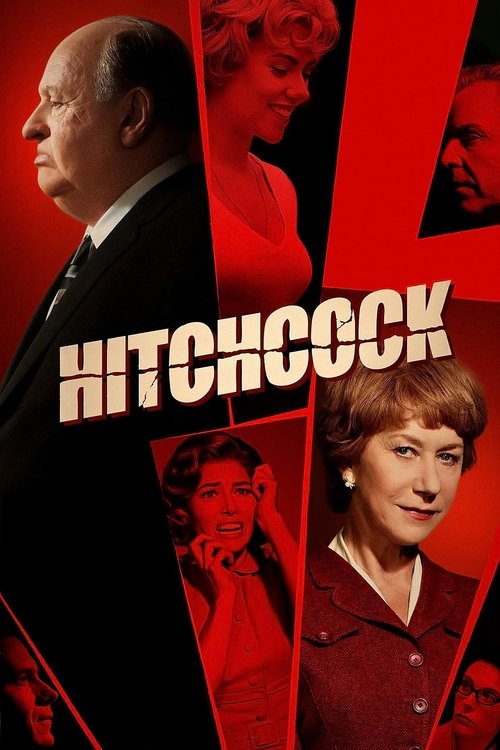



Good evening. The movie we’re watching tonight centers on a man consumed by murder. It’s a story about violence, deception, envy, and greed. And, unsurprisingly, it’s also a love story. In 1960, Psycho arrived in theaters, marking the start of an important period for American cinema with its jarring music and terrifying scream. The director, Alfred Hitchcock, was as recognizable as his stars. He managed to shock audiences with depictions of violence and perversion that were unlike anything they had seen before, and people wanted more. But who made this possible? What secrets were held within the mind of one of the greatest directors ever? “Let’s have the director of Anvil! The Story of Anvil answer that question!” someone apparently said. That's not meant as criticism. Sacha Gervasi did a commendable job telling this behind-the-scenes story about how Psycho was made. However, Hitchcock might more accurately be called Hitchcocks, because it includes Alma Reville, Hitchcock’s wife and creative partner. Using the making of Psycho as a backdrop, Gervasi explores the often difficult but ultimately rewarding relationship between the two British immigrants. Hitchcock was known to be challenging to work with; his extraordinary talent resulted in precise, sometimes confusing instructions for his staff. Alma possessed equal skill and served as his lifelong editor, script consultant, confidante, and advisor. Sir Anthony Hopkins and Dame Helen Mirren lead the cast, portraying Psycho’s characters alongside Scarlett Johansson (as Janet Leigh), James D'Arcy (as Anthony Perkins), and Jessica Biel (as Vera Miles). The actors all give their best efforts, particularly Johansson, who delivers a wonderful performance that captures Janet Leigh's class, warmth, and intelligence, and D'Arcy, who perfectly portrays the nervous energy of Anthony Perkins. Danny Huston’s portrayal of screenwriter and potential suitor to the neglected Alma is the only weak link; he seems to be playing for cheap laughs, as if he wandered in from a film actually made in 1960. This performance feels out of place compared to the naturalistic acting elsewhere in the movie. Hopkins and Mirren carry the film, clearly enjoying their roles as two beloved figures from England. Hopkins wears extensive makeup to resemble Hitchcock’s appearance, and while his voice is different, he captures Hitchcock's distinctive speech patterns and mannerisms, making him look remarkably like the original. But it’s his portrayal of a man, not just a historical figure, that truly works. His version of Hitchcock retains the director’s dry wit and detachment but also reveals genuine pathos and vulnerability. Mirren seems to relish her role as Hitchcock's support system, radiating strength as she prepares for any challenge, whether from studio executives or her husband. Their interactions are what keep the film alive and engaging. The movie is generally well-made, although the subplot involving Whitfield Cook’s attempt to woo Alma feels unnecessary and poorly executed. The scenes where Hitchcock is haunted by Ed Gein (Michael Wincott), the murderer who inspired Robert Bloch's Psycho novel, are strange but function as a dramatization of the creative process; anyone familiar with developing an idea knows that characters can feel very real. This describes the film overall: it’s imperfect and a little odd, but highly enjoyable. It moves along at its own pace, in a structured yet unconventional way. Many of the technical aspects are impressive (especially the cinematography by Jeff Cronenweth and the art direction), though not everything is perfect. The editing is weak, which is disappointing considering the film’s subject matter. But ultimately, you'll be glad you spent time with these people.
On September 29, 2026
#12268▲ 3033
12268th by Pulse movie online3.9PULSEPulse MeterOur daily Pulse Meter measures public activity and popularity signals across the web.How it works →