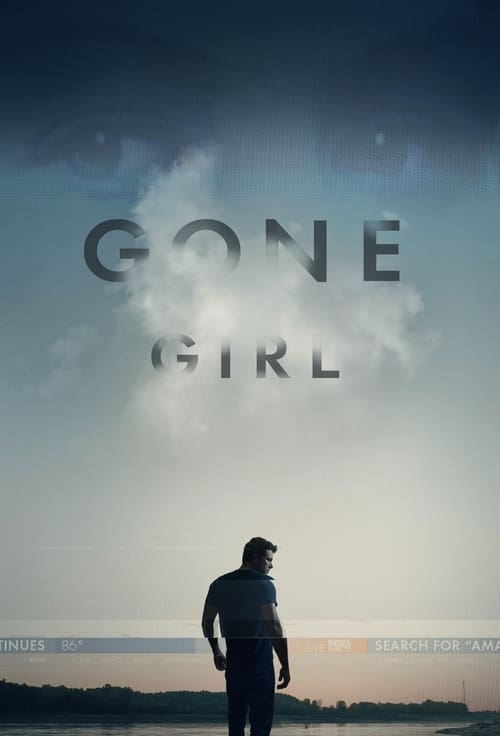





This is it. The last David Fincher film I’ll be able to review before *Mank*, his next project—I hope it's a masterpiece. I’ve previously reviewed *Se7en*, *Fight Club*, *Zodiac*, *The Social Network*, and now it’s time for Fincher’s latest, *Gone Girl*. It’s clear that Fincher prefers to collaborate with familiar faces; Jeff Cronenweth has been his director of photography on roughly half his movies, as has Kirk Baxter in editing, along with Trent Reznor and Atticus Ross composing the music. Even his production designer, Donald Graham Burt, has worked with him since *Zodiac*. However, Fincher consistently brings in new writers, and this time he partnered with Gillian Flynn, the author of the novel that inspired the film. I usually approach adaptations with caution because writing a book isn't the same as crafting a screenplay—they’re entirely different processes. Nevertheless, Flynn completely exceeded my expectations, delivering one of the best scripts of 2014. Her screenplay is remarkably effective in developing each aspect of the story, from Amy’s baffling disappearance to the exploration of how the press and media cover such events. The clever use of time stamps allows the viewer to follow the unfolding events in detail through various perspectives, primarily those of Amy and Nick. The film's greatest strength lies in its ability to demonstrate how the media shapes audience perception of the characters, much like it does in real life. People often don’t even bother reading articles fully, understanding their context; a single headline, however inaccurate, can spark widespread online debate. The same applies to television news programs—if something appears on national broadcasts, many people assume it must be true. I might have been too skeptical about adaptations earlier, but I'm certain of this: always take news reports with a grain of salt because the complete and accurate story is rarely revealed. Ben Affleck ( *Justice League*, *The Way Back*) delivers what I consider one of the finest casting choices of the decade. Throughout his career, Affleck has been relentlessly pursued by journalists eager to expose his personal life, often in disrespectful ways. Nick faces a similar situation; there’s constant media coverage surrounding Amy, and it quickly escalates to accusations that he's a terrible husband and, ultimately, the obvious killer—despite the lack of concrete evidence. Affleck doesn't even need to invent new aspects for his character because his own experiences lend authenticity and brilliance to his performance. He is certainly one of my favorite actors working today. Regarding performances, it’s worth noting Rosamund Pike (*Radioactive*), whose portrayal of Amy stands in contrast to Affleck’s seemingly straightforward yet powerful display; Pike's role is far more complex and layered. She can be menacing and frightening, but also loving and kind. The mystery surrounding her disappearance largely revolves around a shifting perspective, as the viewer sees events through different viewpoints during the first half of the film. This is likely Pike’s best performance to date, showcasing an incredible range as she embodies a character of extremes. Carrie Coon (*Margo Dunne*) is another actress I greatly enjoy watching, and she's excellent as Nick’s sister. Their on-screen chemistry is spot-on, and I sincerely hope she becomes one of the most sought-after actresses in Hollywood. Tyler Perry (*Tanner Bolt*) also does a good job as Nick’s lawyer, but Kim Dickens is even better as Detective Rhonda Boney, who partially represents the viewer by trusting what she sees and hears to be the complete truth. Flynn's screenplay is full of unexpected twists—some more surprising than others—but the third act delivers a truly shocking revelation that leads to a powerful ending that left most viewers, myself included, speechless. There are only two minor drawbacks. One involves Neil Patrick Harris (*Desi Collings*); while he’s a capable actor, I feel he wasn't quite right for this particular role. This is a classic Fincher film: dark, somber, depressing, and tragic, with its share of violence and blood—including one scene featuring an especially disturbing use of blood. While Harris is a good actor, he doesn’t blend in seamlessly with the rest of the cast. The other issue is a minor quibble regarding a few plot points that stretch believability just a bit. Nevertheless, this remains a phenomenal film and further proof of David Fincher's exceptional visual filmmaking abilities. Once again, Fincher collaborates with his trusted team to create a distinctive look and feel. With seamless editing, a memorable score, and impressive camera work, *Gone Girl* is technically superb, but it’s Gillian Flynn’s debut screenplay that truly shines. The narrative is incredibly engaging thanks to its clever structure and puzzling mystery, maintaining excitement and interest throughout. Ben Affleck delivers a standout performance as a man whose life is deeply affected by the press and media—a clear message for audiences to question what they read—while Rosamund Pike gives her career-best performance with an emotionally devastating portrayal. Despite some miscasting of Neil Patrick Harris in such a dark film, and a few minor plot concerns, everything else elevates this into one of the best films of the 2010s. Rating: A
On September 28, 2026
#1136▲ 306
1136th by Pulse movie online52.6PULSEPulse MeterOur daily Pulse Meter measures public activity and popularity signals across the web.How it works →