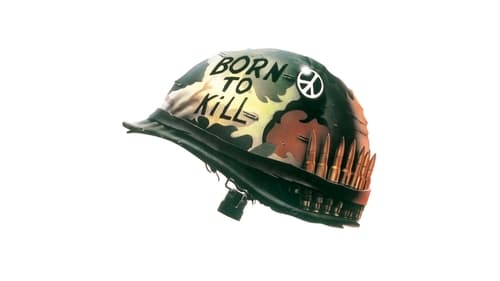





The 1986 movie *Full Metal Jacket* comes from Stanley Kubrick and is based on a novel by Gustav Harford, a Vietnam veteran known for being withdrawn and cynical, with additional writing from Michael Herr, an acclaimed journalist who covered the war. The story unfolds in two distinct sections, though both are experienced through the perspective of young U.S. Marine J. T. "Joker" Davis (Matthew Modine). Initially, we see Davis going through Marine basic training alongside a diverse group of recruits under the harsh leadership of Gunnery Sergeant Hartmann (R. Lee Ermey). Joker observes as Hartmann relentlessly torments Gomer Pyle (Vincent D'Onofrio), an overweight and not particularly bright recruit, until Pyle violently retaliates. Later, stationed in Vietnam as a military journalist during the Tet Offensive, Davis finds himself on the front lines, witnessing firsthand the brutality of war alongside his fellow Marines. It’s unusual for films to be so divided into contrasting parts with different settings and tones, with few characters appearing in both. *Full Metal Jacket* has often left audiences feeling unsatisfied because the initial training sequences are so compelling that the rest struggles to measure up. This is largely due to R. Lee Ermey's performance; he was actually a drill instructor during Vietnam and initially intended only as a technical consultant before Kubrick allowed him to play the role and improvise. His portrayal is marked by intense realism, along with cleverly worded insults and profanity that no writer could have created. When I was younger, I shared this disappointment, feeling let down after the humor and easygoing atmosphere of boot camp faded. However, over time, my appreciation for the film has deepened considerably. The two-part structure now seems like a powerful contrast: one section represents order, while the other embodies chaos. Moreover, the second half offers a poignant commentary on the senselessness of war. While searching for an enemy they can’t even identify and understanding little about their beliefs or culture, Joker and his unit find themselves targeted by a sniper. Several men die before the sniper is located and eliminated, and this loss feels entirely pointless—it doesn't lead to any tangible advantage for either side. The senselessness of World War I trench warfare, where soldiers could lose their lives over minimal gains in territory, appears to have continued during America’s involvement in Southeast Asia. Despite its strengths, the film isn't without shortcomings. One noticeable issue is the inaccurate depiction of Vietnam’s landscape. Kubrick disliked traveling abroad and insisted on filming everything in East London, bringing in only a few palm trees as substitutes for the authentic humidity and insect life of Southeast Asia. The scene portraying a bustling Vietnamese town square shows just a handful of cars circling repeatedly. It's surprising that a director known for his meticulousness could overlook such details about locations—a problem that worsened with his final film, *Eyes Wide Shut*, which featured an artificial New York City setting. There are also some historical inaccuracies that the filmmakers and their advisors should have caught. Nevertheless, even a flawed Stanley Kubrick movie remains a classic work of cinema.
On September 24, 2026
#176▲ 295
176th by Pulse movie online58.3PULSEPulse MeterOur daily Pulse Meter measures public activity and popularity signals across the web.How it works →