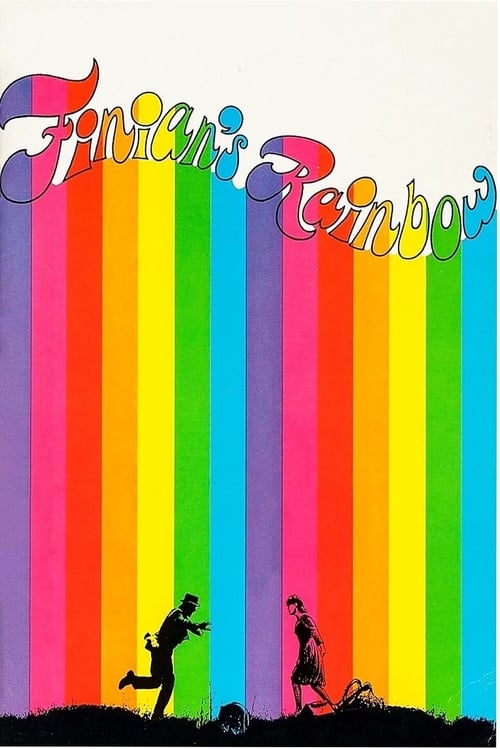




This is a diverting musical from the late 1960s, featuring lively performances by everyone involved. An Irish father and daughter relocate to America, establishing themselves near Fort Knox in Kentucky. As Sharon (played by Petula Clark) develops feelings for the town’s returning native son (Don Francks), Finian (Fred Astaire) finds himself dealing with a leprechaun (Tommy Steele) who is desperate to reclaim the pot of gold he temporarily “borrowed.” Meanwhile, a non-speaking dancer captures the attention of the leprechaun (Barbara Hancock). "Finian’s Rainbow" (1968) offers an enjoyable experience based on the 1947 stage production, and Francis Ford Coppola directed it after demonstrating his abilities with "You're a Big Boy Now." While lengthy, it combines elements reminiscent of Elvis Presley’s “Follow That Dream,” Astaire musicals, and "The Wizard of Oz.” The cast members mentioned above are all standouts, as are Keenan Wynn portraying the racist Senator and Al Freeman Jr. as the research botanist. Astaire was 68 years old during filming, while Petula Clark was 34; Don Francks appeared older at 35, and dancer Barbara Hancock was just 17. She is particularly memorable in her scenes of dancing and acrobatics. Some critics have suggested that the film incorporated too many hippie influences from "Hair," but this criticism seems unfounded. Filming began with a completed script in late June 1967, well before “Hair” premiered off-Broadway four months later; it didn't reach Broadway until 1968 and its movie adaptation wasn’t released until 1979. The writers and Coppola undoubtedly attempted to make the 1947 musical more relevant to the mid-1960s, but this had nothing to do with copying "Hair." I personally didn't notice any noticeable similarities to “Hair,” and it could easily have been set in the late 1940s. The character played by Keenan Wynn was inspired by the actual Theodore Bilbo of Mississippi, a Democrat who passed away seven months after the musical’s debut. Film studios were hesitant to produce it because of the satirical commentary on racism (such as the Senator comically transforming into an African American man), unless they could rewrite the script—something the writers refused to allow. However, by the mid-1960s, the climate was right for such a project. Coppola had no involvement in the editing that cropped Astaire's feet out of some dancing sequences. After filming in 35mm, Warner Brothers decided to convert the movie to the wider 70mm format and market it as a “preserved-ticket roadshow attraction.” This was accomplished by trimming the top and bottom portions of the image frame, which unfortunately included some shots showcasing Astaire's footwork—something I didn’t even notice while watching. This film marked Fred Astaire’s final musical performance. The movie has a running time of 2 hours and 25 minutes and was filmed on studio sound stages and back lots at Warner Brothers Burbank Studios, Walt Disney’s Golden Oak Ranch, as well as Potrero Valley, Thousand Oaks. Several scenes were also shot in Napa Valley near Coppola's home, north of Oakland, and another west of there in Bodega Bay. The opening sequence features scenic shots of recognizable locations across the USA (using stand-ins for Astaire and Clark). GRADE: B
On September 29, 2026
#9307▲ 233
9307th by Pulse movie online4.9PULSEPulse MeterOur daily Pulse Meter measures public activity and popularity signals across the web.How it works →