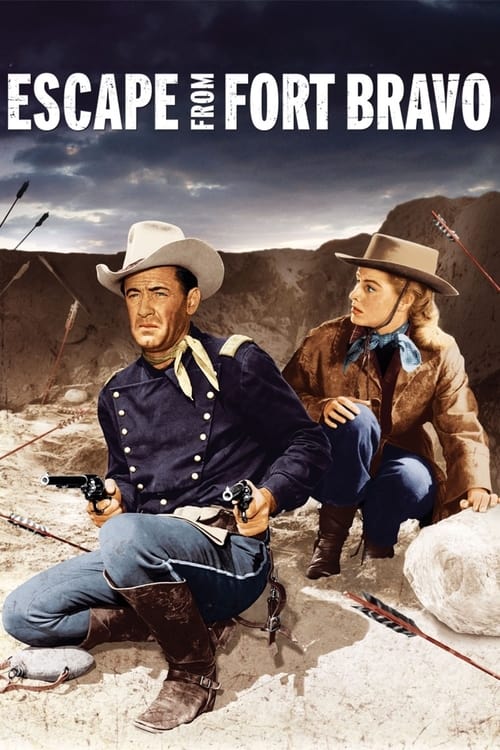




When you’re gone, Beecher, how you ended up there won’t seem so important. Escape from Fort Bravo was directed by John Sturges, with the screenplay written collectively by Michael Pate, Phillip Rock, Frank Fenton, and John Forsythe. The film stars William Holden, Eleanor Parker, John Forsythe, William Demarest & William Campbell. Jeff Alexander composed the music, and Robert Surtees served as cinematographer, primarily filming in and around Death Valley, California. "In 1863, during the War Between the States, a sizable group of Confederate prisoners was detained at a sun-drenched stockade located in Fort Bravo, Arizona Territory. Captor and captive—these men wearing blue and gray uniforms—regarded each other with animosity. A shared threat observed them both—the dangerous Mescalero Indians." Escape from Fort Bravo offers several elements worth noting. 1953 marked the year William Holden ascended to “A” list status, earning substantial paychecks; during this period, he also starred in Stalag 17 and received an Academy Award for Best Actor. The film also showcases the development of John Sturges into a skilled action director, who would later be recognized for films such as Bad Day at Black Rock, Gunfight at the O.K. Corral, The Magnificent Seven, and The Great Escape. Of interest is that it was filmed using Ansco Color, an American offshoot of German Agfa Color, previously used by MGM, which eventually evolved into Metrocolor. Regarding the film itself, it’s entertaining and well-paced, with enough happening in its final section to prevent it from feeling ordinary. The core concept is strong; we find ourselves in a distinctive situation where the prisoners within this stockade are not chained or confined. Due to the severity of the surrounding desert environment and the presence of hostile Native Americans, Holden’s weathered Union captain doesn't consider it necessary to properly secure the men. Following that, there’s an elaborate “infiltration” of the stockade, which is where the film falters somewhat as too much time is devoted to developing a potential romantic relationship. Fortunately, Sturges manages to bring everything together for a compelling final act, forcing adversaries to unite in order to survive. This portion features psychological maneuvering and a memorable attack from the Mescalero warriors. The acting is consistently good, with Holden naturally standing out in one of his characteristic brooding performances, while Surtees skillfully captures both the beauty and harshness of Death Valley. A significant strength lies in Jeff Alexander’s score—a composer often overlooked (Jailhouse Rock/Party Girl). The film's title song, "Yellow Stripes," performed by Stan Jones, is effectively integrated throughout; it was also featured in John Ford's Rio Grande in 1950. We also hear the gentle melody of “Soothe My Lonely Heart” (also used in Cat on a Hot Tin Roof), and Alexander cleverly incorporates this to reflect the film’s tempo and tone. It’s an excellent score that would have been appropriate for any top-tier Western. There's some noticeable studio work that detracts from Surtees’ outdoor photography, and the previously mentioned excessive length of the romance subplot. However, it remains a solid production and consistently enjoyable. 7/10
On October 1, 2026
#47153
47153rd by Pulse movie online1.7PULSEPulse MeterOur daily Pulse Meter measures public activity and popularity signals across the web.How it works →