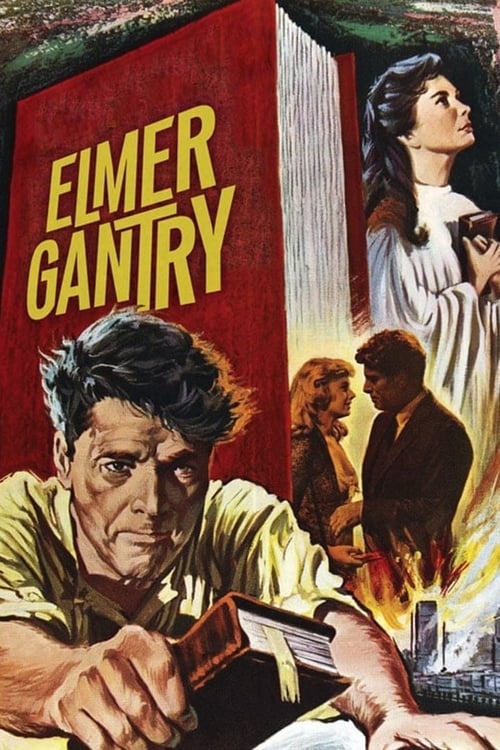




The film tells a story of traveling religious revivalists during the nineteen twenties in America. A fast-talking salesman from Missouri (played by Burt Lancaster) finds himself drawn to the group led by an appealing evangelist (Jean Simmons). After demonstrating his ability as a captivating preacher, he joins their “road church” show, but a woman from his past appears and threatens to disrupt things (portrayed by Shirley Jones). Arthur Kennedy takes on the role of a reporter who travels with them by train. "Elmer Gantry," released in 1960, is adapted from less than one-quarter of Sinclair Lewis’s 1927 book, written by an author who transitioned from agnosticism to atheism. The movie alters the two central characters, presenting them in a sympathetic light, which makes them feel more complex and interesting. This change improves the film compared to the novel—at least the sections it was based upon. It’s worth noting that Jean Simmons' character, Sharon Falconer, was inspired by the well-known but controversial Aimee Semple McPherson. It is important to view this movie separately from the book. The underlying message remains somewhat unclear and allows viewers to form their own conclusions, which I consider a characteristic of good art. Although it’s not overtly anti-Christian, the film critiques how religious revivals can attract charismatic individuals with questionable backgrounds and morals, inevitably leading to problems that could have been avoided through better judgment. The movie's portrayal of the title character is quite compelling. Initially, he seems content enjoying himself at a Christmas bar, but then readily abandons it all to passionately assist a Salvation Army worker in collecting donations. Shortly after, he’s penniless and without shoes, yet finds himself drawn to an energetic worship service held within a Black community where congregants look at him with curiosity, until he happily joins them in singing "Canaan Land" to demonstrate that he's just like them, regardless of his race: A man seeking the Creator and salvation or redemption. Essentially, the film explores how people in positions of power struggle between indulgence and spirituality—a situation most viewers can probably understand. But, as Jim Lefferts (Kennedy) observes, "We don’t want our gods to be human." While there are definitely some interesting aspects to this movie, such as the depiction of 1920s Middle America and Shirley Jones looking her best, “The Apostle” with Robert Duvall offers a less contrived experience that addresses similar themes more effectively. It's somewhat ironic that Sinclair Lewis created Elmer Gantry as someone with an affinity for alcohol, given that the author himself died in 1951 due to severe alcoholism. Running two hours and twenty-six minutes, the film feels about thirty minutes too long. Filming took place at studios in Culver City and Hollywood, along with the Columbia/Warner Brothers ranch in Burbank, except for the Tabernacle sequence which was filmed in Santa Monica. GRADE: B-/B
On September 29, 2026
#4846▲ 172
4846th by Pulse movie online7.7PULSEPulse MeterOur daily Pulse Meter measures public activity and popularity signals across the web.How it works →