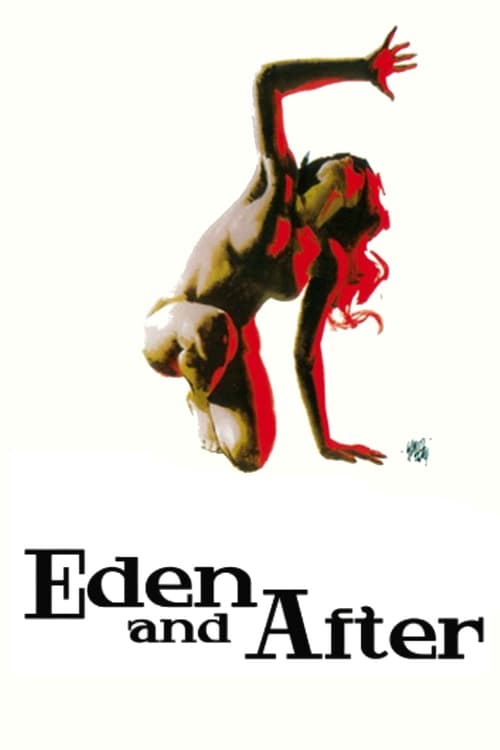





“eden and after” unfolds in three distinct locations: eden itself, a factory situated nearby, and a coastal region in the Middle East that dominates the film’s latter half. Eden is presented as a peculiar space—a nightclub, playground, Piet Mondrian installation, and hall of mirrors all rolled into one. Those outside Eden speculate about the hedonism and criminal activity within, while the inhabitants engage in elaborate games and rumors simply to alleviate their boredom. They exist without responsibility, emotion, or truth, filling their time with wordplay, unusual role-playing exercises, hallucinogenic drugs, and staged mourning rituals. Franz, a waiter who pretends to be strange and threatening, serves drinks. This seemingly charmed existence is disrupted by the arrival of an outsider. Violette (Catherine Jourdan), a young woman from Eden, experiments with a mysterious substance and experiences disturbing visions and sensations. She quickly becomes central to a frightening sequence set within the industrial landscape surrounding Eden. Upon returning home, she discovers that a valuable abstract painting—her only possession—has been stolen, prompting her journey to the Middle East in an attempt to recover it. There, she finds a reality far more unsettling and harsh than the sheltered fantasy world of Eden. It's remarkable how Robbe-Grillet manages to be both strikingly clear with his allegories at times and completely baffling at others. The title and plot certainly suggest a loss of innocence, functioning as a metaphor for the transition from youth to independence and also reflecting the sixties counterculture’s disillusionment. However, this doesn't fully unlock the film’s deeper meanings. Much of the film’s power comes from its mythic quest narrative, relying more on the emotional and psychological impact of individual images—whether unsettling, erotic, or simply visually interesting—than on explicit metaphors or fables. One aspect I appreciate about “eden and after” is how it explores the nature of reality and abstraction. Like several directors whose work I admire, Robbe-Grillet blurs the lines between fantasy and reality. However, unlike Terry Gilliam or Jean-Pierre Jeunet, the film doesn’t favor fantasy through a system of values that celebrates imagination and novelty. In films like “Trans-Europe-Express” and “eden and after,” venturing outside of reality brings with it potential danger alongside new possibilities. Robbe-Grillet's perspective on fantasy versus reality is ambiguous. It isn’t even clear how the central contrast (“Eden” versus “after”) should be understood. Is Eden a protected fantasy world, while the external chaos represents reality? Or could the passionless emptiness of Eden symbolize bourgeois life, with the intense escapades outside being the exciting dreams that Edenites desire? (At one point, a bored gambler expresses a longing to play roulette with real bullets.) Regardless, Eden is no paradise, and the outside world bears little resemblance to our own, making it difficult to definitively interpret the film. Ultimately, the relationship between “Eden” and “after” remains my primary focus of interest. The role-playing and storytelling within Eden seem to mirror Violette’s journey outside, suggesting that Eden is a kind of training ground or simulation. The hallucinations triggered by the mysterious powder appear to be accurate glimpses into the future. Are we meant to believe that everything "after" Eden is simply an extension of this drug experience, no more real than anything else, or does it represent a predetermined fate? And what should we make of Violette’s cherished abstract painting, which turns out to be a landscape displayed sideways—a possession she eventually dismisses as “that absurd little painting”? The film's visual style changes with each setting, but the overall tone remains consistent. Robbe-Grillet demonstrates his fascination with image construction, particularly through the use of strong lines dividing the frame, color relationships, and the contrast between abstract geometric shapes and the complexities (and often sensuality) of the human form. His approach to interior design and architecture is stark and uninviting, whether it’s the colored partitions and mirrored walls of Eden, the industrial metalwork of the factory, or the white-walled domes and blue accents in the Middle Eastern village. There's a recurring sexual element to his work, most notably in scenes involving bondage and captivity (a theme also present in “Trans-Europe-Express”). Robbe-Grillet’s eye for composition is all the more impressive considering his background as a novelist. There’s much more to discuss about the film, and I'd like to highlight several individual sequences after another viewing. It speaks effectively for itself, and I don’t want to reveal too many surprises. Like many art house films that I recommend, it’s hard to predict which viewers will find it rewarding enough to seek out. A good indication of whether someone would appreciate “eden and after” is if they enjoy the work of at least two of the following directors: Terry Gilliam, Alejandro Jodorowsky, Alain Resnais, Luis Buñuel, and Raoul Ruiz.
On October 2, 2026
#38771
38771st by Pulse movie online1.9PULSEPulse MeterOur daily Pulse Meter measures public activity and popularity signals across the web.How it works →