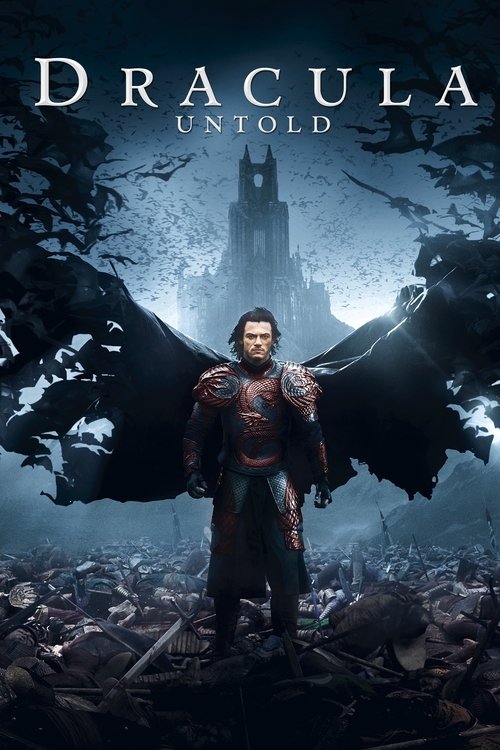




Bram Stoker's *Count Dracula* provides a textbook example of what I call my Evil Iceberg Theory—the less you know about and see of a villain, the more effective they are. In the novel, the central figure is unique in that he doesn’t record his thoughts in letters or diaries, unlike other characters like Dr. Seward. If, as Lovecraft suggested, fear is humanity's oldest and strongest emotion, and the most profound kind of fear stems from the unknown, then Dracula embodies this perfectly; he is mysterious, unknowable, unreachable, and impossible to reason with. It’s pointless to attempt to assign him any complex motivations—like a shark in *Jaws* or Hannibal Lecter, he kills simply to sustain himself. Considering all of this, it's easy to see why *Dracula Untold* doesn't quite work out. The story is narrated by Ingeras (Art Parkinson), Vlad III Draculea’s son—also known as the Impaler, Son of the Dragon, Son of the Devil, and Dracula—long after the events transpired, yet in a strangely childlike voice. We can just call him Vlad (Luke Evans). "In the year of our Lord 1442, the Turkish sultan enslaved 1,000 children from Transylvania to serve as soldiers." One of these boys grew up to become Vlad, who “disgusted by his terrible actions ... buried his past and returned to Transylvania to rule peacefully.” It’s as if he just abandoned the problem. Someone really should have explained slavery to that Sultan. Despite this, Wallachia and Transylvania remain under Ottoman control, and Vlad must pay an annual tribute to Sultan Mehmed II (Dominic Cooper). One is left wondering why these two groups are so hostile toward each other, especially given their shared use of British English. Mehmed decides to enslave another thousand children (perhaps the first thousand managed to escape), including Ingeras. Vlad refuses, and knowing that this will lead to war, seeks help from "a vampire." The explanation follows: “From the Greek word pi, meaning ‘to drink’—though actually 'pi' is a Greek letter; the language in which it is a word that means 'drink' or 'suck' is Albanian.” This creature was once a mortal man who summoned a demon to gain power, but the demon tricked him and condemned him to an eternity trapped in a cave until he could find someone else to free him. The vampire (Charles Dance), formerly a Roman and thus speaking, like all Romans in films, flawless English, gives Vlad some of his blood, granting him “a taste of my power. The strength of 100 men. The speed of a shooting star. Command over the night and its creatures. The ability to see and hear through your senses. Even heal grievous wounds ... Once you drink, you’ll crave human blood constantly. But if you can resist for three days, you will return to normal, having experienced my power, and perhaps saved your people.” There's a caveat: "[What if I feed?]" "I will be freed by providing the darkness with a worthy offering. You will become … like me. A curse on everything you love… I, however, will be free to unleash my wrath against the one who betrayed me. And someday, I will call upon you to serve me, my pawn, in an immortal game of revenge.” This all just proves that sometimes silence is the best explanation. Consider Coppola’s *Dracula*, whose introduction—featuring modern Romanian dialogue with archaic English syntax (perhaps not historically accurate but still better than English-English)—shows Gary Oldman plunging a sword into a chapel's stone cross and drinking the blood that flows from it. It may not make perfect sense, but at least it’s concise, and Coppola doesn’t even bother to explain it. *Dracula Untold*, on the other hand, piles on excessive exposition, which only creates more questions than answers. How did this Roman end up in Transylvania? Are there no caves in Rome? Why can't he leave the cave while Vlad can? What does "an immortal game of revenge" even mean? The phrase feels like an oxymoron. Coppola was the second to merge the character of Dracula with the historical figure, and add a romantic subplot involving reincarnation (the first was Dan Curtis’s 1974 *Bram Stoker's Dracula*, written by Richard Matheson). Director Gary Shore and screenwriters Matt Sazama and Burk Sharpless repeat this formula in *Dracula Untold*, but their mistake is stretching the premise into an entire movie. If they had done a little more research, they would realize that Vlad’s connection to the character is tenuous at best, and that Stoker likely used the name 'Dracula' under the mistaken impression that it meant ‘devil’ in Romanian—though perhaps the confusion of 'Greek pi' with Albanian 'pi' was a subtle nod to this linguistic error on the author’s part.
On September 27, 2026
#1616▲ 4093
1616th by Pulse movie online51.0PULSEPulse MeterOur daily Pulse Meter measures public activity and popularity signals across the web.How it works →