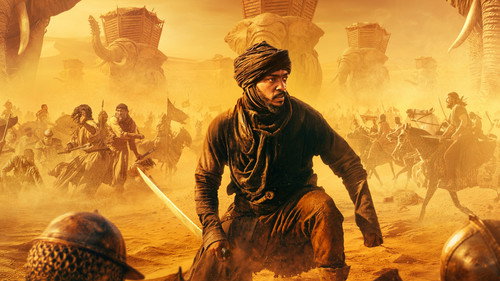





Desert Warrior (2025) is positioned as taking place "1500 years ago" in Arabia, where tribes were battling over territory and water. And seemingly everyone speaks English. It’s easy to imagine there would have been even more conflict if each group had its own language or dialect. According to the opening title cards, “In a bid to take control[,] Emperor Kisra II of the Sassanid Empire demands all tribal Kings [sic] turn over their daughters as concubines. Those [sic] that refuse are hunted into harsh desert where only the strongest survive.” The strongest, and those created by computers. I find myself questioning how this unusual formula could possibly assist Khosrow (or “Kisra,” as they call him) in consolidating his power, especially since he seems to already possess a great deal of it if he can issue and enforce such an order. It also feels like a load of nonsense – similar to the questionable droit du seigneur elements from Braveheart. There must be several well-documented reasons for conflict during that time and place; the movie itself mentions two believable ones: water and land. Why invent a situation where heroes and villains are fighting over a woman? The reason is, I suppose, it’s a convenient way to represent a few things. Initially, it establishes Kisra as an ambitious tyrant — something Ben Kingsley’s brief appearance doesn't quite manage to convey. Secondly, it suggests that Hanzala (Anthoy Mackey) may be after gold but also possesses a good heart when he defends Princess Hind (Aiysha Hart). And finally, there’s the #MeToo element; Kisra II is retroactively cast as a villain due to having multiple wives at once, and we can't overlook the need to impose modern values on ancient history regardless of what was customary then. What Desert Warrior lacks in historical accuracy, it somewhat compensates for with its depiction of location, particularly during the first portion of the film. The desert looks as unforgiving as described, and the action sequences feel appropriate to the setting. It's as if the filmmakers intentionally ignored the past fifty years to create an experience that feels historically inaccurate but visually reminiscent of older epics. That was my perspective until they presented a “panoramic” view of Ctesiphon, the former capital of Iranian empires. I realize seventh-century Ctesiphon isn’t somewhere you can send a film crew for establishing shots; however, it could have been recreated like London in the opening scene of Henry V. While the "exterior" shots resemble those from 300, the interiors, specifically Kisra’s court/arena, look like something out of Caligula. Kingsley delivers a restrained performance when he should be overacting in the style of Malcolm McDowell. There are numerous other scenes and shots that could charitably be described as “composites” throughout the film — mainly landscapes, armies, and a group of war elephants which made me long for the documentary-like realism of Babar — none of which quite match the movie’s overall aesthetic. Desert Warrior concludes with a caption stating that Kisra II was "poisoned by an unknown assassin. There are those who believe it was a concubine.” Really? Who exactly holds that belief? Well, “those” people.
On September 24, 2026
#2400▼ 245
2400th by Pulse movie online51.2PULSEPulse MeterOur daily Pulse Meter measures public activity and popularity signals across the web.How it works →