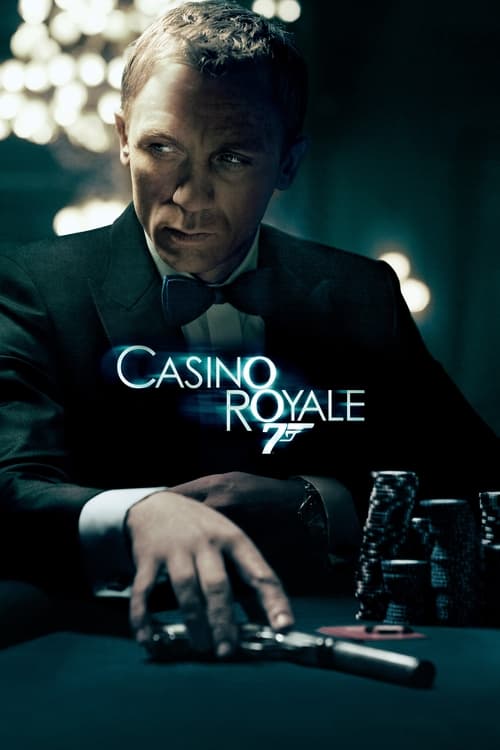





Arrogance and self-awareness don’t often coexist. Casino Royale, directed by Martin Campbell and adapted by Neil Purvis, Robert Wade & Paul Haggis from a story by Ian Fleming, stars Daniel Craig, Eva Green, Mads Mikkelsen, Judi Dench, Jeffrey Wright & Giancarlo Giannini. It marks the 21st film in the James Bond series. The plot follows Craig’s character as he is promoted to 00 status and thrown into a world of high-stakes terrorism. It's notoriously difficult to get a James Bond movie right, given the passionate fanbase. There will inevitably be complaints—some will say there aren’t enough gadgets, others that it strays too far from Ian Fleming’s original vision, or that it lacks seriousness. Others will argue the opposite: that it takes itself too seriously. And of course, there's always debate about who should wear the tuxedo; for every fan defending Sean Connery, you can find someone championing Timothy Dalton’s portrayal. After Pierce Brosnan concluded his run with the outlandish Die Another Day in 2002, the pressure on any new Bond—both the actor and the filmmakers—was immense. By 2006, cinema had changed; spy movies were a different breed than before, influenced by films like The Bourne Identity. When it was announced that Bond would be rebooted and Daniel Craig chosen as the new face of the franchise, the backlash was immediate. Critics questioned his appearance: he was too blond, too rugged, not tall enough—and why reboot a beloved series at all? It felt like war, with tensions running high. Casino Royale still has its detractors, but it’s generally considered the most successful Bond film among audiences. The worldwide box office figures speak for themselves, grossing nearly $600 million—a testament to its popularity. In many ways, Casino Royale delivers everything you could want from a James Bond movie, and then some: stunning locations, beautiful women, and intense action sequences that push the stunt department to new heights. It also feels true to Fleming's original story, updated for a post-9/11 world. The film nods to classic franchise elements while streamlining some of the comedic filler from previous installments. Even the villain, Mads Mikkelsen’s Le Chiffre, is well-developed—a man trying to outwit Bond to survive, rather than simply wanting to destroy the world. That's a refreshing and effective approach to a Bond thriller. Despite all the energy and spectacle (enough to fill half a dozen earlier Bond films), a Bond movie ultimately succeeds or fails based on the performance of its lead actor. Thankfully, Craig excels in this regard, bringing physicality, swagger, and raw aggression to the role. What’s particularly striking is that Craig's Bond feels more human than previous iterations—one moment suave and composed, the next bruised, battered, and emotionally conflicted. This is a complex and well-rounded Bond, elevated by Craig’s powerful presence. Eva Green also makes an impression as Vesper Lynd, bringing both intelligence and allure to the role, reminiscent of Diana Rigg's Tracy di Vicenzo in OHMSS—though the character could have been more fully developed. Jeffrey Wright delivers a strong performance as Felix Leiter, Judi Dench’s M is formidable, and Giancarlo Giannini adds continental charm as Bond’s Montenegro contact, René Mathis. The film is complemented by David Arnold's score, which blends traditional Bond themes with energetic bursts, and Phil Meheux's cinematography, which offers visual delights in the Bahamas, Czech Republic, and Italy. Beginning with what could be considered the best chase sequence in the entire franchise and culminating in a quintessential Bond moment, this reboot is exceptional. It’s full of energy, intelligence, and humanity—and proves that James Bond is back: blonder, more brutal, and undeniably better. 9/10
On October 1, 2026
#1086▼ 80
1086th by Pulse movie online8.0PULSEPulse MeterOur daily Pulse Meter measures public activity and popularity signals across the web.How it works →














