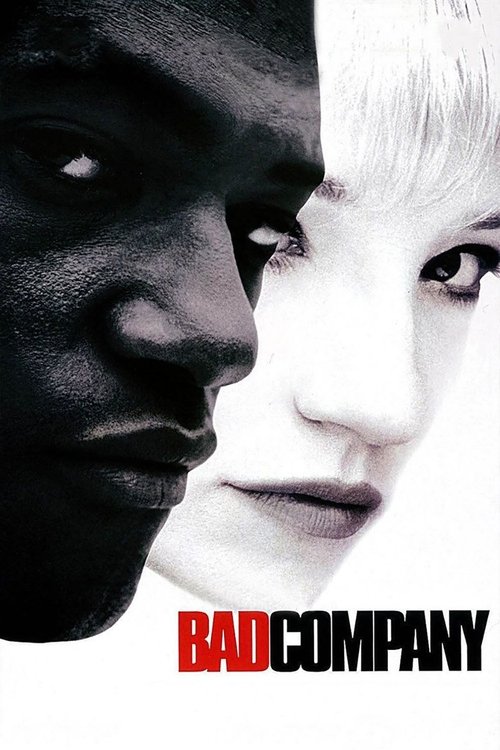




Bad Company functions as a neo-noir take on Deep Cover, which came out three years prior; both movies feature Laurence Fishburne (whose best performances arguably predate The Matrix) portraying an undercover operative infiltrating a criminal enterprise at the behest of a government agency, only to see the distinction between those sides become increasingly unclear, if not entirely erased. The key difference lies in Deep Cover's focus on the protagonist’s internal struggles as the driving force of the story, whereas Bad Company prioritizes surface-level elements—exactly what one expects from a noir film. Former CIA agent Nelson Crowe (Fishburne) is recruited by Vic Grimes (Frank Langella, consistently effective), who runs an organization he calls "The Tool Shed." This firm employs individuals with intelligence backgrounds to offer their skills in extortion and corporate espionage to companies both within the United States and abroad. Margaret Wells (Ellen Barkin), Grimes’s second-in-command, begins working alongside Crowe and seduces him, drawing him into a scheme to assassinate Grimes so they can assume control of the company. During a clandestine meeting, it is revealed that Crowe is a CIA operative working under duress. He was dismissed from the agency due to suspicion of stealing a $50,000 bribe intended for an Iraqi colonel. William 'Smitty' Smithfield (Michael Murphy), Crowe’s former supervisor, threatens him with imprisonment over the missing bribe as leverage to get Crowe to infiltrate The Tool Shed. The CIA intends to acquire the company and transform it into a covert operations hub, with Smitty at its helm. Simultaneously, Todd Stapp (Michael Beach), seemingly the final member of The Shed, uncovers Crowe’s true identity but instead of reporting this to Grimes, he chooses to assist Smitty and Crowe in seizing control of the organization. All of this logic is questionable. Why would the CIA, itself a clandestine agency, want to take over another one? According to Smitty, they'd secure “our own private, self-sustaining special operations boutique at no cost to the taxpayer.” However, given that the Director of the CIA is the only federal employee who doesn’t need receipts for government spending, I doubt he cares about "the taxpayer" (it also seems suspicious that Smitty asks Crowe to sign a receipt for $1 million intended as a bribe for a Supreme Court justice; it turns out this is just a convenient plot device to give Crowe something to use against Smitty later). Stapp’s motivations are also unclear. Crowe tells him, “the Agency wants the Tool Shed … Margaret and I will run it … I guess that makes you No. 3,” which is mathematically correct but not particularly appealing, considering there would only be three people left in The Shed once Grimes is out of the picture. Ultimately, this film directed by Damian Harris and written by Ross Thomas takes a convoluted route to reach a straightforward conclusion: no one is blameless, and everyone meets their end. This actually works well—it’s the journey that matters more than the destination; the fact that the outcome is morally justifiable is an added benefit. As mentioned, it's noir—and Fishburne and Barkin’s relationship echoes that of Fred MacMurray and Barbara Stanwyck in Double Indemnity; like theirs, their passion appears to be a pretext and disappears after Grimes’s death. When Crowe tells Margaret she is “the girl of my dreams,” adding that if she weren't, then nothing they’ve done would make sense, she might respond, akin to Phyllis to Walter Neff, that "I never loved you … I used you, just like you said. That's all you've ever meant to me.” Except Margaret has no difficulty whatsoever with a second attempt—she fires without hesitation.
On September 30, 2026
#15455▼ 1089
15455th by Pulse movie online3.1PULSEPulse MeterOur daily Pulse Meter measures public activity and popularity signals across the web.How it works →