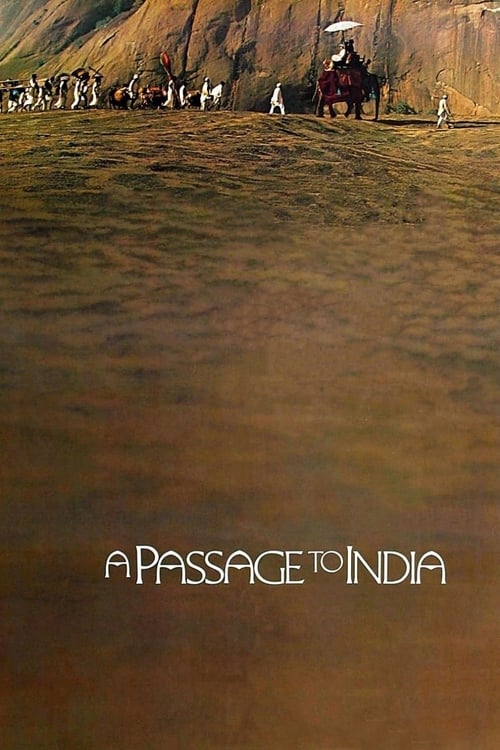





While the movie succeeds in portraying the vibrant and detailed world of India, it feels like a lost chance due to issues with how the story was written. This represents director David Lean’s final work, from a filmmaker who gave us several worthwhile films, with “Lawrence of Arabia” and “Doctor Zhivago” standing out as particularly strong examples for me. Here, he presents an adaptation of a novel I haven't read but which must be quite good; the story unfolds in India during the period between wars, beginning with the arrival of two Englishwomen, one of whom, Miss Quested, is engaged to a local English judge. Over time, they become acquainted with Aziz, a Muslim doctor. Quested already possessed a desire for adventure and wanted to experience India’s essence, but she was consistently let down by her fellow countrymen, who judged Indians and preferred to replicate British customs and environments in that country, avoiding any “risky” blending with people of a "darker race" and a more "barbaric" culture. Eventually, Quested persuades Aziz to organize an expedition to some distant caves, but the trip goes wrong, something happens, and Quested subsequently accuses Aziz of attempted rape. I believe the film ultimately comes across as a rather weak adaptation; captivated by the exotic settings, Lean overlooked the most important themes within the narrative: the prejudiced relationship, full of mistrust and bias, between the English and Indians; the political question of Indian independence (which gains importance as the story progresses); and the uncertainty surrounding what truly occurred between Quested and Aziz, since the novel doesn’t offer a clear answer regarding the validity of her accusation. These themes are poorly handled in the script: it's obvious in the film that Aziz is innocent, and Quested is transformed into a frivolous, vague, and unhappy woman who lacks direction and craves an intense emotional experience that social norms won’t allow. Furthermore, the script barely acknowledges the independence issue, reducing it to a minor detail; and despite effectively addressing British racist prejudice, it almost entirely avoids exploring how Indians viewed the British and felt offended by their excesses. Everything is overly softened. Beyond the script's shortcomings, the film is also excessively long. Scenes are drawn out unnecessarily, with many minutes devoted to beautiful and well-executed sequences that don’t advance the plot. A considerable amount of time is wasted on rather trivial conversations, while the legal proceedings, which should have been a central element, feel secondary. And instead of concluding directly after the verdict, with a few scenes showing the characters' fates, the film continues for another thirty minutes, resulting in an anticlimactic and uninteresting ending. The actors do their best, and there are some commendable performances: Victor Banerjee is the most remarkable actor, the most compelling and charismatic figure, demonstrating his character’s evolving beliefs as his opinion of the British gradually deteriorates due to events. Peggy Ashcroft also delivers a solid performance, but the script relegates her to a supporting role. The same can be said for Sir Alec Guiness, who is underutilized in a minor part with little significance. James Fox appears at intervals, and the plot suggests his character will follow a particular trajectory, though the ending doesn’t quite align with expectations. Judy Davis, despite putting in effort, portrays an unlikeable and unpleasant character, so her work isn't entirely successful. Lean truly shines in the technical aspects, thanks to the rich and elegant cinematography, beautifully colored, which is complemented by the excellent sets, costumes, and careful selection of filming locations, all emphasizing India’s exotic and mysterious nature. The bustling market scenes and the evocative ruins are prime examples of this. One can only wish they had captured the smells! Even more disappointing is Maurice Jarre's soundtrack; it feels completely out of place and gives the film an unintentionally comedic feel.
On October 3, 2026
#4135▼ 64
4135th by Pulse movie online4.6PULSEPulse MeterOur daily Pulse Meter measures public activity and popularity signals across the web.How it works →














