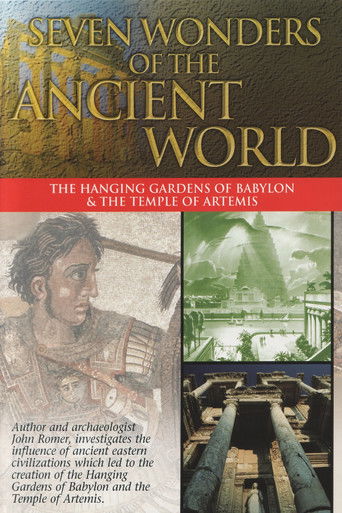
Seven Wonders of the Ancient World Collection
7 movies · 1994–2004
The Seven Wonders of the Ancient World Collection is a film series released between 1994 and 2004, comprising seven films with a total runtime of 349 minutes. The collection's films explore various aspects of ancient civilizations, focusing on iconic structures and historical sites. These installments offer a glimpse into the wonders of the ancient world, with individual film lengths ranging from 45 to 52 minutes. Examples of films within the collection include "Seven Wonders of Ancient Egypt" (2004), which has an IMDb rating of 6.2, and "Seven Wonders of the Ancient World: The Wonders of the East" (1994). The series spanned ten years, with each film having a budget and revenue of zero. The collection's total runtime is 349 minutes across its seven films. This series of films presents distinct explorations of different regions and wonders of the ancient world.
Franchise cast


All movies in chronological order
 Seven Wonders of the Ancient World: Simply The BestThis film explores the origins of the "New Man" ideal throughout history. Host John Romer examines how monumental sculptures like the Colossus of Rhodes and the Statue of Zeus at Olympia shaped popular perceptions of the human form. The colossal Statue of Zeus, adorned with ivory and gold, dominated the Olympic Games, its presence amplified by a pool of olive oil reflecting light. The bronze Colossus of Rhodes stood as a guardian of the island. Remarkably, both sculptures depicted faces modeled after humans. This image continues to resonate today, most notably in our Statue of Liberty.0.1
 Seven Wonders of the Ancient World: The Wonders of the EastHost John Romer examines the impact of ancient Eastern cultures. The legendary Hanging Gardens of Babylon, once thought to be part of King Nebuchadnezzar's palace in Iraq, are now considered more myth than reality by scientists. Meanwhile, the Temple of Artemis in modern-day Turkey, dedicated to the mother goddess, was a sacred site for many, including the Romans who called her Diana and the Anatolians who knew her as Kybele. It stood as one of the most important shrines in the world during the time of Alexander the Great.0.1
 Seven Wonders of the Ancient World: The Magic MetropolisJohn Romer journeys to the locations of two ancient cities built by Alexander the Great, cities renowned for their beauty and uniqueness. The episode also looks at the culture and environment that fostered the creation of several of the world's seven wonders. It focuses on the Pharos lighthouse in Alexandria, a structure exceeding 300 feet tall and the tallest of its time, and the Mausoleum at Halicarnassus, considered one of the greatest tombs ever built. Unlike typical tombs of the era, the Mausoleum was decorated with statues of real people, intended to inspire citizens by suggesting they could achieve greatness comparable to the gods.0.1
 Seven Wonders of the Ancient World: Ghost of WonderArchaeologist and author John Romer examines the mystical significance of the Seven Wonders, with a particular focus on the enduring allure of the Pyramids. He then explores the city of Rome, envisioned as a magical place enclosed by a wall representing the days of the Creator's rest. The city contained 365 squares, streets, and palaces for the popes, each with 365 steps covered in bread – a symbol of abundance and a longing for a legendary past filled with wealth and wonder. *Ghosts of Wonder* shows how the stories of the Wonders reflect the modern imagination, following Romer's journey from Australia to New York to demonstrate how people continue to be captivated by the echoes of the ancient world.0.1
 Seven Wonders of Ancient RomeThe Seven Wonders of Ancient Rome – the Pantheon, Aqueducts, Via Appia, Baths of Caracalla, Trajan's Markets, Circus Maximus, and Colosseum – were created by ambitious Emperors like Hadrian and innovative engineers such as Apollodorus. These structures inspired awe and represented the height of human accomplishment, transforming Rome into the center of the world by the second century AD.0.1
 Seven Wonders of Ancient EgyptIn the earliest days of civilization, the ancient Egyptians achieved the seemingly impossible. Before machines, using only copper as their strongest metal, powerful pharaohs like Khufu and Ramses II proved that immense ambition and countless workers could transform stone into breathtaking monuments. From elaborate tombs in the Valley of the Kings to the iconic Great Pyramid, they raised structures that dominated their civilization and continue to inspire awe across Africa and the world. This documentary explores the secrets of Egyptian pharaohs, engineers, and architects, vividly recreating these magnificent buildings as they would have appeared to the ancient Egyptians.0.1
 Seven Wonders of Ancient GreeceGreece: a place of stunning beauty and light. Here, science, art, and divine inspiration led to incredible architectural achievements. The ancient Greeks used their buildings to express the diversity of their society, creating the first theaters, organizing athletic competitions, and worshipping in some of history's most impressive temples.0.1













